

Time Active
Artist Statement
Nam June Paik (Korean: 백남준; July 20, 1932 – January 29, 2006) was a Korean American artist. He worked with a variety of media and is considered to be the founder of video art.[He is credited with the first use (1974) of the term "electronic superhighway" to describe the future of telecommunications.
bio
exhibition
Paik's first exhibition, entitled "Exposition of Music - Electronic Television", was held in 1963 at Galerie Parnass in Wuppertal, Germany. A retrospective of Paik's work was held at the Whitney Museum of American Art in the spring of 1982. Major retrospectives of Paik's work have been organized by Kölnischer Kunstverein (1976), Musée d'art moderne de la Ville de Paris (1978), Whitney Museum of American Art in New York (1982), San Francisco Museum of Modern Art (1989), Kunsthalle Basel (1991) and National Museum of Contemporary Art in Seoul (1992). A final retrospective of his work was held in 2000 at the Guggenheim Museum in New York, with the commissioned site-specific installation Modulation in Sync (2000)[29] integrating the unique space of the museum into the exhibition itself.[30] This coincided with a downtown gallery showing of video artworks by his wife Shigeko Kubota, mainly dealing with his recovery from a stroke he had in 1996.
In 2011, an exhibition centered on Paik's video sculpture One Candle, Candle Projection (1988-2000) opened at the National Gallery of Art in Washington, D.C.[31] Another retrospective was mounted at the Smithsonian American Art Museum in Washington, D.C., in 2012–2013.[32][33] As a leading expert in Paik's work, art historian John G. Hanhardt was the curator for three landmark exhibitions devoted to the artist, the ones at the Whitney Museum, the Guggenheim Museum, and the Smithsonian American Art Museum.[34]
Paik's work also appeared in important group exhibitions such as São Paulo Biennale (1975), Whitney Biennial (1977, 1981, 1983, 1987, and 1989), Documenta 6 and 8 (1977 and 1987), and Venice Biennale (1984 and 1993).[4]
From April 24, 2015, to September 7, 2015, Paik's works T.V. Clock, 9/23/69: Experiment with David Atwood, and ETUDE1 were displayed at "Watch This! Revelations in Media Art" at the Smithsonian American Art Museum.[35]
Latest/Featured work
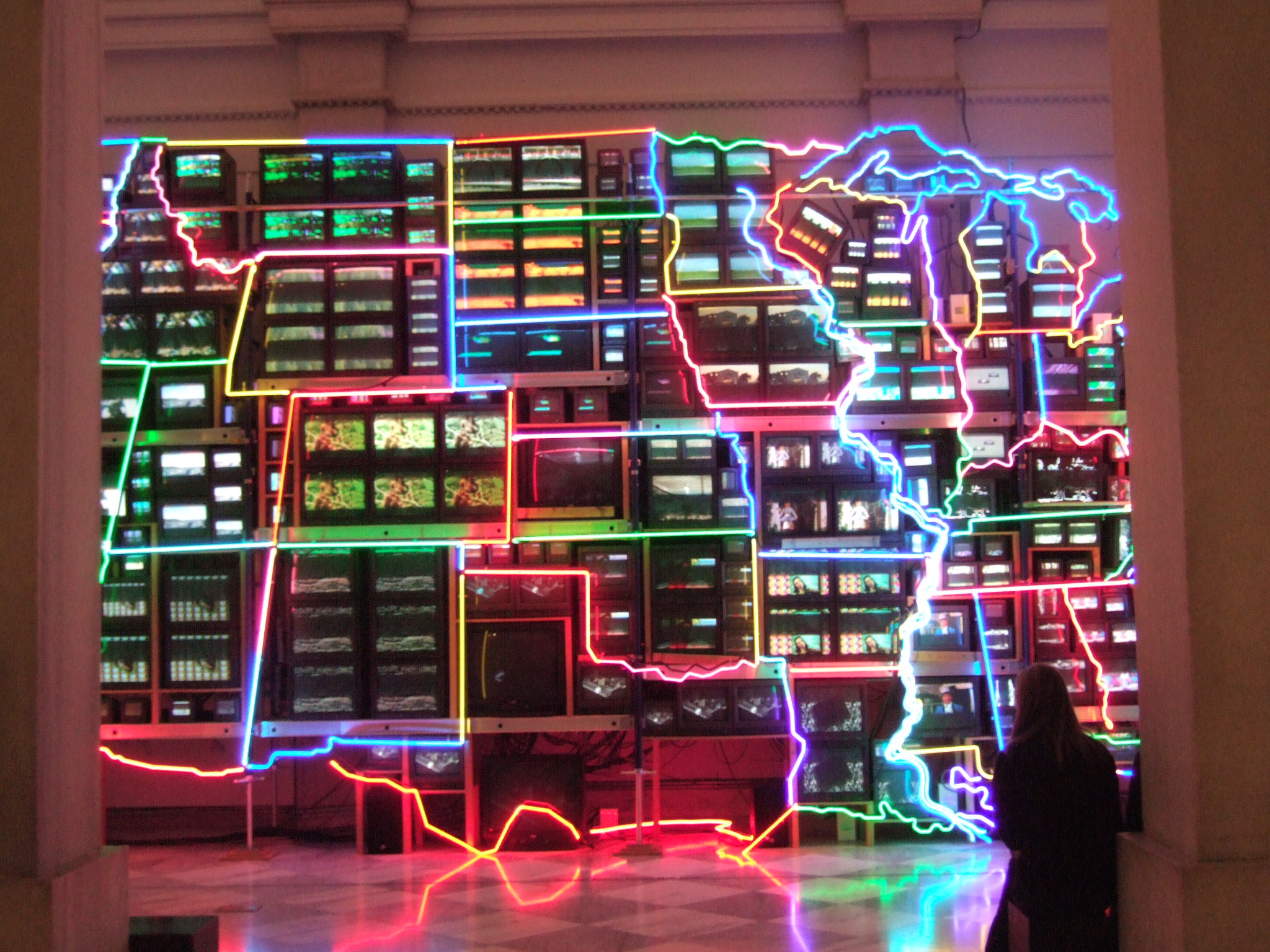
Megatron Matrix by Nam June Paik at Smithsonian Art Museum, 3rd Floor, North Wing
8-channel video and 2-channel sound multi-media installation http://americanart.si.edu/collections/search/artwork/?id=36486 It's in the permanent collection, so check it out!
keywords
5 Times Artist Nam June Paik...
Nam June Paik was a...

Nam June Paik – ‘My Crazy...
Inventor Ken Hakuta remembers his...

Megatron Matrix by Nam June Paik...
8-channel video and 2-channel sound...
Nam June Paik’s PBS (1963-2000)
Korean-American artist Nam June Paik...
